
Toilet Repair and Installation in Milton Keynes
Tell Us About the Job
Tell us about the job in two minutes and we’ll come back to you with a clear, fixed price.
The most expensive toilet fault is the one you cannot hear. A flush valve that has stopped seating properly lets water trickle continuously from the cistern into the pan, twenty-four hours a day, and on a modern dual flush design it frequently does it silently.
If your water bill has risen and you cannot explain it, this is the first thing to check, before anyone starts looking for leaks under floors.
We repair, install and unblock toilets across Milton Keynes and the surrounding towns, in homes, rental properties and commercial premises. Gas Safe registered, registration number 981362.
- Gas Safe registered 981362
- Fixed price agreed before we start
- Milton Keynes and 20 miles around
- 8am – 8pm, Mon to Sat
Last updated
What goes wrong
The silent running cistern
Modern dual flush toilets use a drop valve sitting in the base of the cistern. Debris, scale or a perished seal stops it seating, and water passes straight through into the pan. Because it runs down the back of the pan rather than splashing, you often cannot hear it.
How to test it in two minutes: put a few drops of food colouring in the cistern, do not flush, and come back in half an hour. If there is colour in the pan, the valve is passing.
This is worth doing on every toilet in the house if your bill has jumped. Water companies see this as one of the largest sources of unexplained consumption in domestic property, and in a hard water area like Milton Keynes the seals scale and fail faster than they would elsewhere.
The cistern that keeps filling
A fill valve that will not shut off. Either the float arm or float cup has slipped, the valve washer has failed, or debris is holding it open. Water then runs continuously to the overflow, which on modern toilets discharges into the pan rather than through the wall, so again it is not obvious.
Weak or incomplete flush
Usually the flush valve seal, the water level in the cistern set too low, or on a concealed frame system a flush plate mechanism that is not travelling fully. Occasionally a partial blockage in the pan trap or the waste.
Leaks at the base
Water appearing around the foot of the pan is usually either the pan connector seal or the flexible supply connection, not the pan itself. Both are straightforward. Leaving it is not, because the water soaks into flooring and subfloor and does real damage before anyone notices.
Blockages
Wet wipes are the leading cause, including the ones labelled flushable. They do not disperse the way toilet paper does. Combined with fat from the kitchen waste run they produce exactly the blockage water companies keep photographing.
Our blocked drains page covers clearance and diagnosis, including CCTV survey where a toilet blocks repeatedly rather than once.
Concealed cistern problems
Everything above, but behind a wall. This is why concealed systems need a properly sized access panel behind the flush plate. A good installation leaves you a route to the valve and the isolating valve. A bad one means removing tiling to change a washer.
If you are specifying a concealed frame, ask specifically how the working parts will be reached.
Toilet types and what each needs
Close coupled.
Cistern sits directly on the pan. Simplest, cheapest to maintain, everything accessible. Still the sensible default for most rooms and by far the easiest to live with in a rental.
Back to wall with concealed cistern.
Pan against the wall, cistern hidden in a frame or furniture unit. Looks better, needs an access panel designed in, and costs more to maintain.
Wall hung.
Pan fixed to a supporting frame with nothing touching the floor. Best for cleaning and for the look of a small room. Requires a properly installed frame rated for the load, which is not a job to improvise.
Macerator systems.
Where a conventional waste route to the soil stack is not achievable. Covered on our Saniflo and macerator page. Useful, occasionally the only option, and worth understanding the maintenance implications before committing.
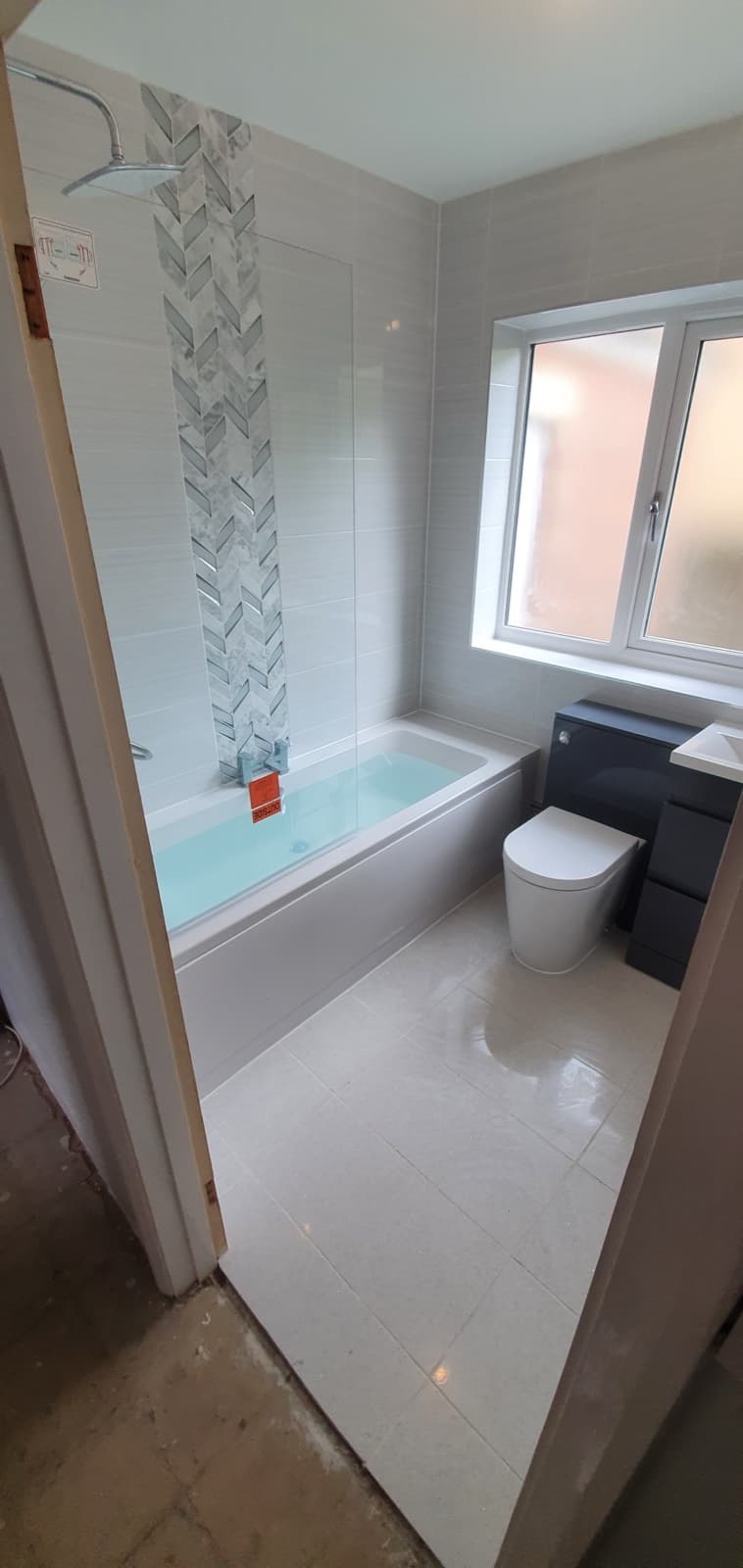
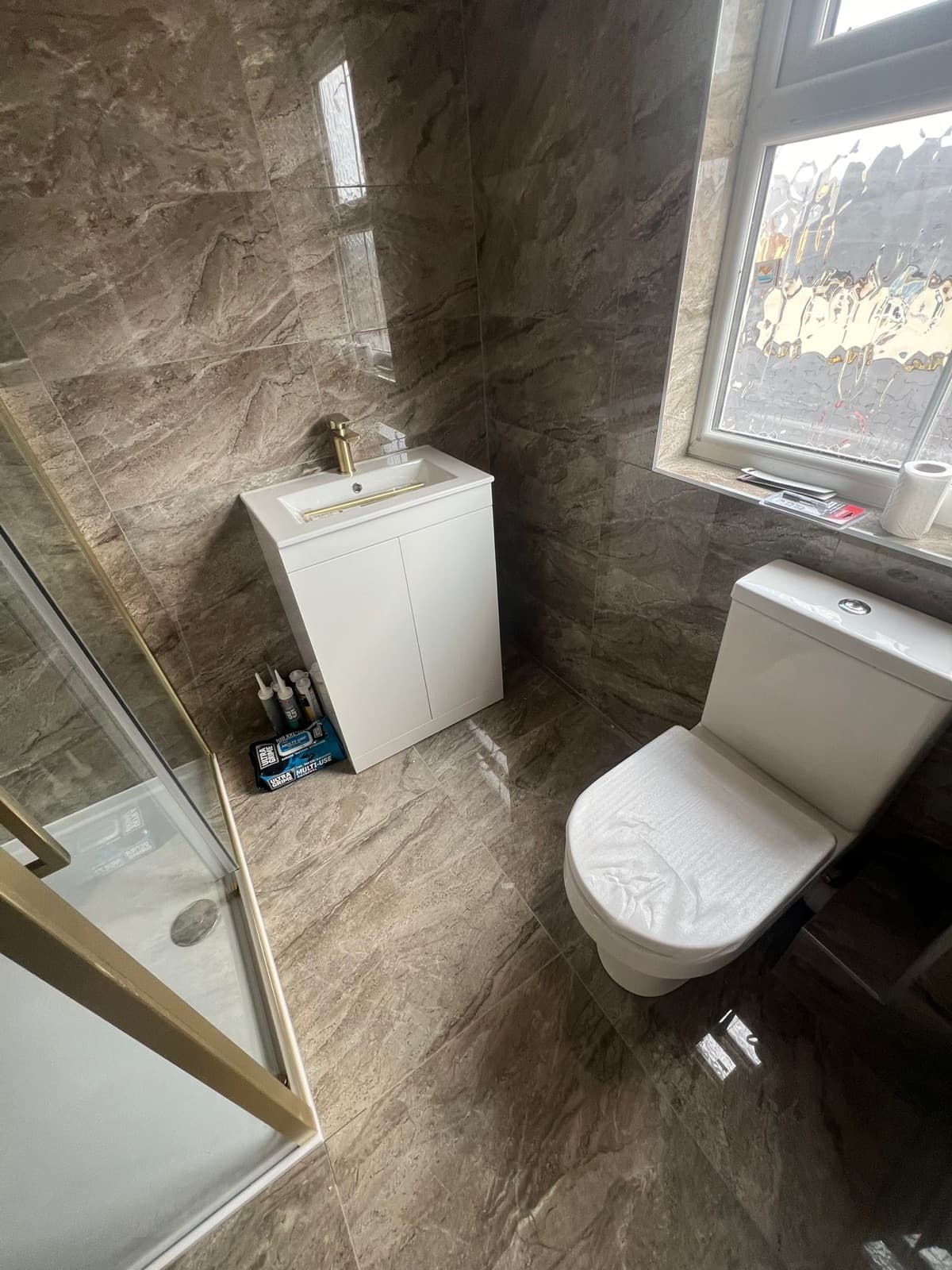
Moving a toilet: the constraint nobody plans for
Toilets need a route to the soil stack with an adequate fall. That is the single biggest limit on bathroom layouts and it is the thing people plan around last, after they have already decided where everything goes.
Short moves are usually straightforward. Longer moves need either a boxed waste run at the right gradient, which affects the room, or a macerator, which brings its own considerations.
Before you commit to a layout, get the waste route confirmed. It is a short conversation that prevents a long problem, and it is covered as part of the planning on our bathroom plumbing page.
Toilets in Milton Keynes: the local picture
Hard water. At around 300 mg/l across the city and roughly 317 in MK8, against a UK average of 207, scale affects toilets in two specific places: the flush and fill valve seals, which fail earlier here, and the rim and pan, which stain faster. The dye test above is worth doing annually in this area rather than only when a bill looks wrong.
1970s estates, Beanhill, Coffee Hall, Netherfield, Fishermead and Conniburrow. Compact bathrooms and cloakrooms with soil stacks in fixed positions, so layout changes need the waste route checked first. Many of these properties also share drainage runs, which matters when a blockage affects more than one house.
1980s and 1990s estates, Furzton, Emerson Valley, Shenley Brook End and Loughton. Straightforward installations, and the age at which original cisterns and valves are all reaching end of life together.
Newer estates, Brooklands, Whitehouse, Fairfields, Oakgrove, Tattenhoe Park and Glebe Farm. Frequently concealed cisterns and wall hung pans as standard, which means access panels matter and a lot of owners do not know where theirs is until something fails.
Older property in Stony Stratford, Newport Pagnell, Olney and Wolverton. Solid floors and original stack positions, and occasionally waste routes that were improvised decades ago and have been working on borrowed time since.
Repair or replace
Repair
for running cisterns, failed fill or flush valves, leaking connections, seized isolating valves and most blockages. These are inexpensive parts and there is rarely a reason to replace a sound pan and cistern because a washer has failed.
Replace
when the pan is cracked, when the cistern is crazed or leaking through the ceramic, when parts for an older concealed system are genuinely unavailable, or when the bathroom is being redone anyway.
Be wary of anyone who quotes a new toilet for a running cistern. It is usually a part.
A short annual check
- Do the food colouring test on every toilet in the property
- Check the isolating valve on the supply actually closes, because scale seizes them and you will want it working when something fails
- Check around the base of the pan for damp
- Check the flush is completing properly rather than needing a second go
- Locate the access panel on any concealed cistern, before you need it
- Nothing down the toilet except what came out of you and toilet paper
Frequently asked questions
My toilet runs constantly. Is that expensive?
Yes. A passing flush valve can waste a very large volume over a month, and it is one of the commonest causes of an unexplained water bill. It is also usually a cheap part.
How do I know if my toilet is leaking into the pan?
Food colouring in the cistern, do not flush, check the pan half an hour later. Colour in the pan means the valve is passing.
Can you fix a concealed cistern without removing tiles?
If there is a properly sized access panel behind the flush plate, usually yes. If there is not, it depends on the system. We will tell you before starting rather than partway through.
My toilet blocks regularly. Why?
Repeat blockages in the same place usually mean something structural rather than something you are doing. That is when a CCTV survey is worth more than another clearance.
Are flushable wipes really a problem?
Yes. They do not break down like toilet paper. They are the most common cause of the blockages we clear.
Can I move my toilet to the other side of the room?
Depends on the route to the soil stack and whether a fall can be achieved. If not, a macerator is an option, with trade-offs we will be straight about.
Do you fit wall hung toilets?
Yes, including the supporting frame. The frame installation is the part that matters and it is not a job to cut corners on.
Do you cover commercial washrooms?
Yes, for offices, shops and small commercial premises.
You may also need
Book a repair
Call 07514 312117 or send a WhatsApp. Gas Safe registered 981362, CIPHE member, fully insured.