Boiler Installation in Milton Keynes
Tell Us About the Job
Tell us about the job in two minutes and we’ll come back to you with a clear, fixed price.
A boiler is the single most expensive thing most people buy for their home that they never actually look at. It sits in a cupboard or on a utility wall, and as long as the radiators warm up and the shower runs hot, nobody thinks about it. Then one January morning it doesn’t, and suddenly you are making a four-figure decision with a cold house and three quotes that all say something different.
We fit boilers across Milton Keynes and the surrounding towns, for homeowners, landlords and commercial premises. The part of the job that matters most happens before any spanner comes out. Getting the right appliance, in the right position, on a system that has been properly prepared, is what separates a boiler that quietly does its job for fifteen years from one that keeps dropping pressure and needs a callout every winter.
This page covers what a proper installation involves, what the regulations actually require, why Milton Keynes water changes the specification, and the questions worth asking any installer before you agree to anything.
- Gas Safe registered 981362
- Fixed price agreed before we start
- Milton Keynes and 20 miles around
- 8am – 8pm, Mon to Sat
Last updated
What a boiler installation actually involves
The survey comes before the price
Any installer who gives you a fixed price over the phone without seeing the property is guessing, and the gap gets closed later with extras. A real survey looks at the gas supply and pipe size, the existing flue route, the condensate run, the radiator count and sizing, the mains water flow rate at the kitchen tap, and the state of the existing pipework.
Flow rate is the one homeowners rarely hear about and it decides everything on a combi. If your mains delivers 10 litres a minute, fitting a 35kW combi will not give you a better shower, because the boiler can only heat what the main can supply. Paying for output you cannot use is one of the more common ways people overspend on a new boiler.
Combi, system or regular
Combi.
Heats water on demand, no cylinder, no loft tanks. Right for most one and two bathroom homes with decent mains pressure. Wrong if two showers run at once, or if the mains flow is weak.
System.
Works with an unvented hot water cylinder. Better for larger homes and anywhere with more than one bathroom in regular use, because stored hot water does not care how many outlets are open. Needs cupboard space for the cylinder.
Regular (heat only).
The traditional setup with a cylinder and feed tanks in the loft. Usually kept when a property has old, delicate pipework that would not take the higher pressure of a sealed system, or when the customer wants a like-for-like swap on a tight budget.
The honest answer is that the property decides, not the price list. A four bedroom house in Brooklands with two bathrooms and an en-suite is a poor candidate for a combi no matter how big the combi is.
What the regulations require in England
Since April 2018, Boiler Plus has applied to every new gas boiler installed in England. In practice it means three things:
- 1
The boiler must achieve at least 92% ErP seasonal efficiency. Every current model from the major manufacturers meets this, so it is rarely a limiting factor, but it does rule out reusing old stock.
- 2
Time and temperature controls must be present and working, which means a programmer and a room thermostat with a boiler interlock.
- 3
If it is a combi, the installation must include one additional efficiency measure: weather compensation, load compensation, a qualifying smart thermostat with automation and optimisation, or flue gas heat recovery.
Part L of the Building Regulations also now requires new and fully replaced wet heating systems to be designed to run at a maximum flow temperature of 55°C, rather than the 75 to 80°C that older systems were set to. Lower flow temperatures make a condensing boiler condense properly, which is where the efficiency actually comes from, but they only work if the radiators are sized for it. This is why a like-for-like boiler swap onto undersized radiators often disappoints people who expected a big drop in their gas bill.
Every installation must also be notified to Building Control, which a Gas Safe registered engineer does through the Gas Safe Register. You should receive a Building Regulations Compliance Certificate afterwards. If you do not, the installation was not notified, and that becomes your problem when you sell the house.
Boiler installation in Milton Keynes: the local picture
Hard water is the specification issue nobody mentions
Milton Keynes is supplied by Anglian Water and the water here is classed as very hard. The average across the city’s postcode districts sits around 300 mg/l of calcium carbonate, and MK8 measures around 317, against a UK average of 207. Anything above 200 is firmly hard. Above 300 is the range that produces visible scale on a kettle element in a matter of weeks.
For a boiler, that matters in two specific places. The first is the plate heat exchanger in a combi, which heats your domestic hot water. Scale builds on it, flow drops, and the classic symptom appears: the shower runs hot, then lukewarm, then hot again. The second is anywhere water is held at temperature, which on a system boiler means the cylinder coil and the immersion element.
There are three sensible responses, and we will talk you through which applies:
- Fit an in-line scale reducer on the cold mains feed to the boiler. Small, inexpensive, and standard practice around here. Some manufacturers require one in hard water areas for the warranty to stand.
- Set the domestic hot water temperature sensibly. Scale precipitates faster the hotter the water gets. There is little reason to run a combi’s hot water at maximum when you then mix it with cold at the tap.
- Consider a full water softener if scale is already causing you problems elsewhere in the house, on taps, shower screens and the kettle.
Skipping this is the most common reason a five year old combi in Milton Keynes gives poor hot water performance while heating the radiators perfectly well.
The housing stock varies more than most towns
Milton Keynes was designated in 1967 and built outwards in phases, which means the property types are unusually stratified by area, and each phase brings its own installation quirks.
The early estates.
Beanhill, Coffee Hall, Netherfield, Fishermead, Conniburrow and Bradville date from the 1970s. A lot of these properties have had two boilers already and are on their third. The recurring issue is small bore pipework and radiators sized for the original system, plus flue routes that were designed around appliances no longer made.
The 1980s and 1990s expansion.
Areas like Furzton, Emerson Valley, Shenley Brook End and Loughton. Typically straightforward installations, though many still have the original system boiler and cylinder arrangement in an airing cupboard, and the decision about whether to move to a combi comes up regularly.
The newer estates.
Brooklands, Whitehouse, Fairfields, Oakgrove, Tattenhoe Park, Glebe Farm. Built to tighter thermal standards, often with underfloor heating on the ground floor, and frequently with the boiler in a first floor cupboard or utility. These are usually the easiest to specify and the fussiest to route condensate from, because there is often no convenient external drain.
Older properties outside the grid.
Stony Stratford, Newport Pagnell, Olney and the Victorian railway terraces in Wolverton. Solid walls, chimney breasts, and in some cases original pipework that has been added to rather than replaced. These jobs take longer and the survey matters more.
Getting around the city
The grid road system is genuinely useful when you are running a boiler installation. We can be across from Two Mile Ash to Bletchley on the V6 or out to Newport Pagnell on the H5 without much drama, which is why we hold a 20 mile radius rather than a tighter one. Woburn Sands, Buckingham, Leighton Buzzard and Bedford are all comfortably within reach.
Choosing the right boiler for your home
Sizing
Oversizing is the default error. An oversized boiler short cycles, firing and shutting off repeatedly instead of running steadily, which wears components and burns more gas than a correctly sized one. The heating output should follow a heat loss calculation for the property, not the output of whatever was there before. On a combi, the hot water output is what drives the kW figure, and that is where flow rate comes back in.
Controls
Since a combi installation needs an additional efficiency measure anyway, a smart thermostat is often the sensible choice because you get the compliance and something genuinely useful. Weather compensation, which adjusts flow temperature based on outside air temperature, is technically the better performer but is less flexible if you later change your heating pattern.
Where it goes
Moving a boiler adds cost. Gas, water, flue, condensate and electrical supply all have to follow it. Sometimes the move is worth it, for example relocating a kitchen boiler into a garage or utility to free up a cupboard. Often it is not. We will tell you which, including when the answer costs us money.
What we do on the day
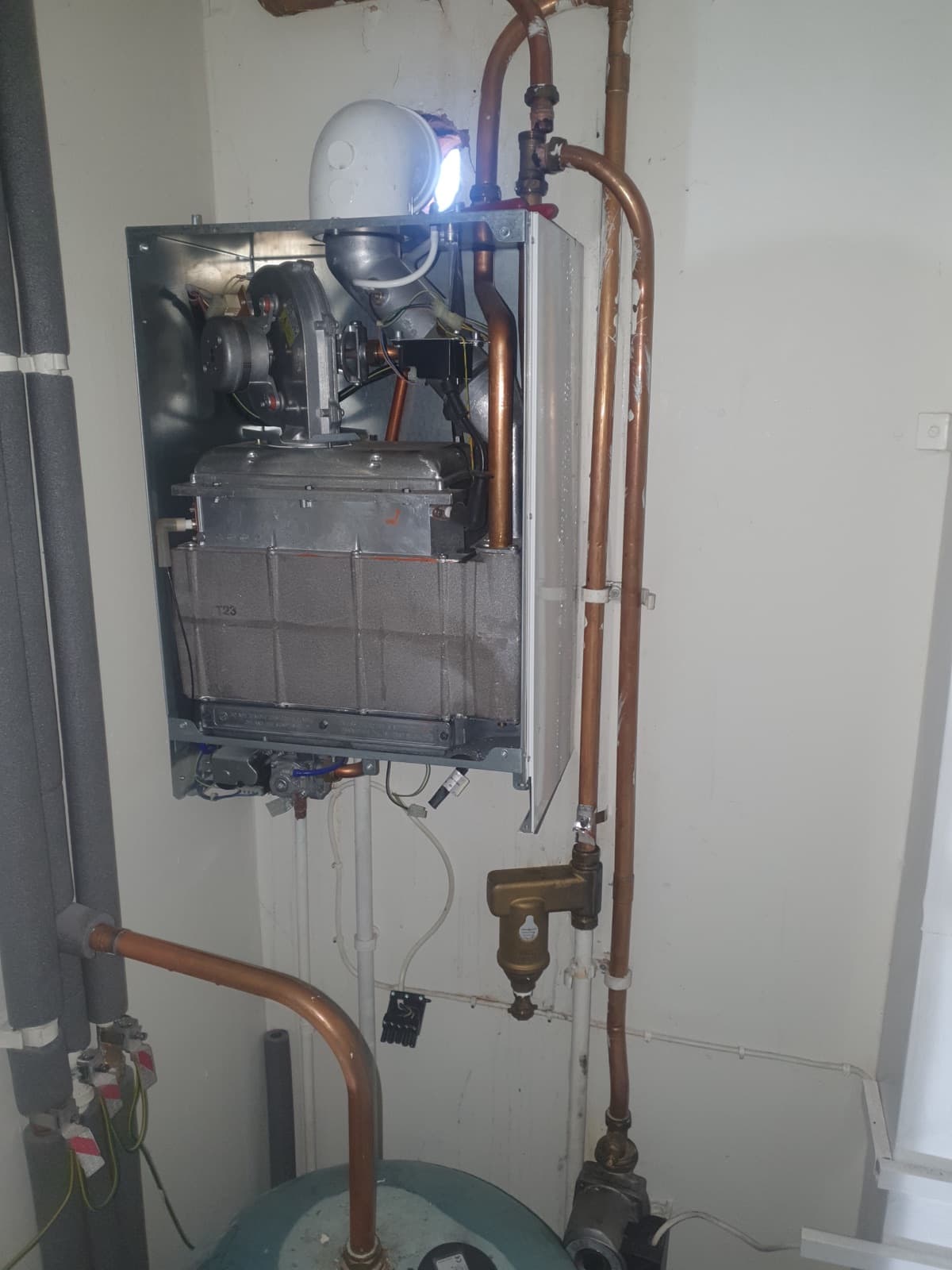
- Isolate, drain and remove the old appliance without spreading system water through the house.
- Chemically flush or power flush the system where the existing water condition calls for it. New boiler, old sludge, is a warranty claim waiting to happen.
- Fit a magnetic filter on the return. Non-negotiable on our installs, and required by most manufacturers for the warranty.
- Fit a scale reducer on the cold mains feed, given the water here.
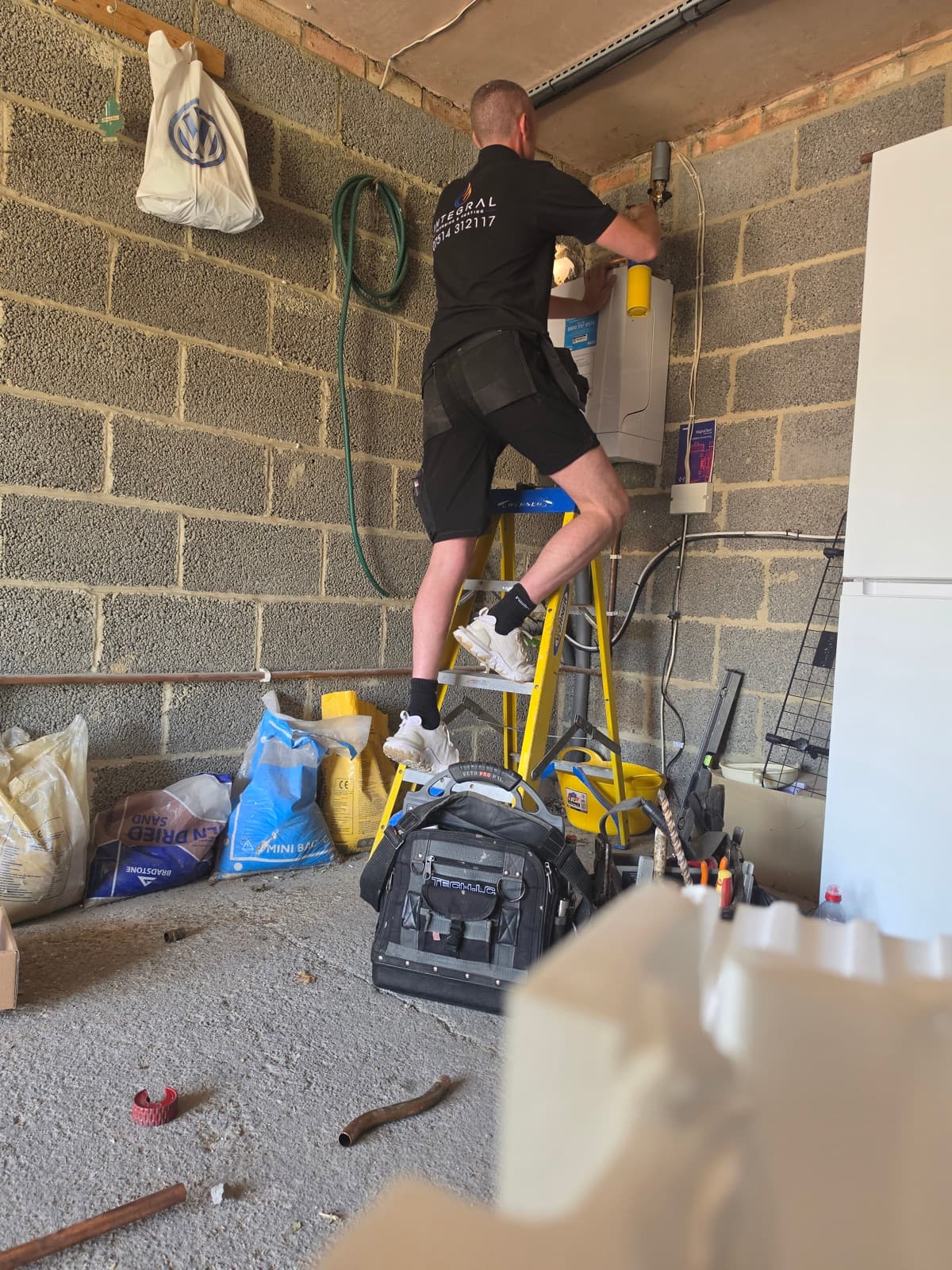
- Install and commission the boiler, set the flow temperature for the system rather than leaving it at factory default, and balance the radiators.
- Complete the benchmark commissioning checklist, register the warranty, and notify Building Control.
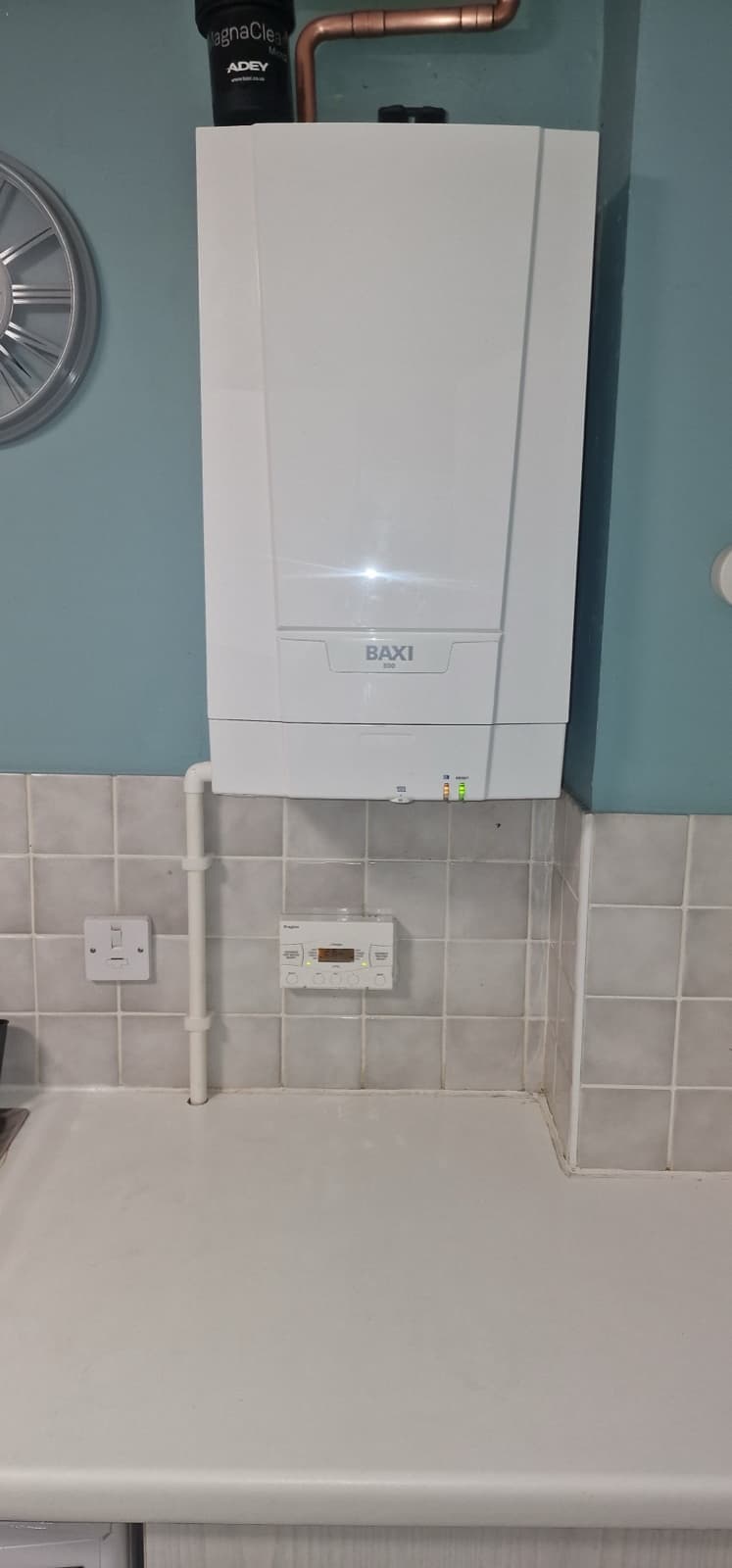
- Talk you through the controls properly, and clear up.
Before you book: a checklist for any Milton Keynes installer
Ask these of whoever you get quotes from, including us:
- Are you Gas Safe registered, and what is your registration number? Ours is 981362. Check any engineer at gassaferegister.co.uk before work starts.
- Did you measure the mains flow rate before recommending a combi?
- What size boiler, and what heat loss figure is it based on?
- Does the quote include a system flush and a magnetic filter?
- Does it include a scale reducer, given the water hardness here?
- Which Boiler Plus efficiency measure is included, and is it in the price?
- Who registers the warranty, and how long is it?
- Will I get a Building Regulations Compliance Certificate?
- Is the price fixed, and what specifically would change it?
- Are you insured, and for how much?
If a quote comes back cheaper than the others, work out which of the above it left out. That is almost always where the difference is.
What affects the cost
The boiler itself is often less than half of it. The variables are:
- Whether you are staying with the same boiler type or converting, for example cylinder system to combi, which means removing tanks and altering pipework.
- Whether the boiler is moving position.
- Flue type and route, including whether scaffolding or a flue extension is needed.
- Condensate route, which is straightforward on a ground floor kitchen and awkward in a first floor cupboard on a newer estate.
- The condition of the existing system and whether a full power flush is needed.
- The control package.
We give a fixed price after seeing the property, and we tell you what would change it before we start rather than after.
Frequently asked questions
How long does a boiler installation take?
A straightforward like-for-like combi swap is usually a day. A conversion from a cylinder system to a combi, or a boiler relocation, is typically two days. If a full power flush is needed we allow extra time rather than rushing it.
Will I be without heating and hot water?
For the working day, yes. We aim to have you back on the same evening on a single day job. If a job runs to two days we discuss temporary arrangements with you beforehand rather than leaving you to find out.
Do I need a power flush with a new boiler?
Not always, but you do need the system to be clean. We test the system water and tell you honestly. Fitting a new boiler onto a sludged system is the fastest way to void the warranty and block the new heat exchanger.
Is a combi right for my house?
It depends on bathroom count and mains flow rate, not on the size of the house on paper. Two bathrooms in simultaneous use usually points towards a system boiler and an unvented cylinder.
Does hard water really affect a new boiler in Milton Keynes?
Yes, and specifically the hot water side of a combi. At the hardness levels here, a scale reducer on the cold feed is worth fitting on every installation, and several manufacturers require one for the warranty to remain valid.
Do you notify Building Control?
Yes. As a Gas Safe registered business, registration number 981362, we notify every installation and you receive the compliance certificate. Keep it with your house paperwork, because a buyer’s solicitor will ask for it.
Can you install a boiler in a flat or an apartment?
Usually, though flue routing and access to the communal areas need checking first, and some blocks have restrictions in the lease. We check this at survey stage.
Do you install boilers in commercial premises?
Yes. Offices, shops and small commercial units are all within what we do. The survey and the compliance requirements differ from a domestic install, so tell us the property type when you get in touch.
You may also need
Areas we cover
Based in Two Mile Ash and working across Milton Keynes and a 20 mile radius, including Bletchley, Wolverton, Stony Stratford, Newport Pagnell, Woburn Sands, Olney, Buckingham, Leighton Buzzard and Bedford. If you are not sure whether we reach you, ask.
- Milton Keynes
- Bletchley
- Newport Pagnell
- Wolverton
- Stony Stratford
- Woburn Sands
- Olney
- Buckingham
- Leighton Buzzard
- Bedford
- Towcester
- Winslow
- Cranfield
- Ampthill
Get a fixed price
Call 07514 312117 or send a WhatsApp with a photo of your existing boiler and we will tell you what your options are. Gas Safe registered 981362, CIPHE member, fully insured. Booked work Monday to Saturday, 8am to 8pm, with emergency cover out of hours.