
Pipework Installation and Repair in Milton Keynes
Tell Us About the Job
Tell us about the job in two minutes and we’ll come back to you with a clear, fixed price.
Pipework is the part of a plumbing system nobody sees and everybody depends on. It is also the part where the decisions made forty years ago decide what is possible today, which is why a new bathroom in a 1974 house is a different job from the same bathroom in a 2019 house.
We install, repair and replace plumbing pipework across Milton Keynes and the surrounding towns, in homes, rental properties and commercial premises. Gas Safe registered, registration number 981362.
- Gas Safe registered 981362
- Fixed price agreed before we start
- Milton Keynes and 20 miles around
- 8am – 8pm, Mon to Sat
Last updated
Materials, and what each means for you
Copper
The traditional standard and still an excellent material. Rigid, durable, tolerant of heat, and it looks tidy where it is visible.
It fails in three places: at soldered joints that have been heated and reheated during previous alterations, at compression fittings that were overtightened or that have been disturbed, and as pinhole corrosion where water velocity is high on a tight bend or where the pipe has been in contact with certain building materials.
Push-fit plastic
Flexible, quick to install, tolerant of freezing better than copper, and perfectly good pipework when it is installed correctly.
Almost every push-fit failure we attend comes from installation shortcuts rather than the material: pipe not cut square, not deburred, not pushed fully to the depth mark, or fitted without the pipe insert that stops the pipe deforming under the O-ring. Those joints can hold for years and then let go with no warning at all.
If you have push-fit and you are having other work done, it is worth asking whether inserts were used.
Microbore
Typically 8mm or 10mm copper running from a manifold to each radiator, common in Milton Keynes housing from the 1970s and 1980s. It installs quickly and it works.
Its weakness is that the small bore silts with magnetite far more readily than 15mm pipe, so a single cold radiator on an otherwise healthy system is frequently a blocked microbore leg. It also limits capacity, which matters when you want to fit a larger radiator or extend a circuit into an extension. Covered further on our radiator page.
Lead
Still present in a small number of older properties. Lead supply pipe is worth replacing rather than repairing, for water quality reasons as much as reliability. Covered on our water supply pipe page.
Galvanised steel
Occasionally found on older installations. It corrodes internally, narrowing over decades, which shows up as poor flow that has been getting gradually worse for years. Replacement rather than repair.
Repair, or replace the run?
Repair a joint when
the pipework either side is sound, the cause is identifiable and one-off, and access is reasonable.
Replace a section when
the pipe is pitted or corroded along its length, the same run has failed before, or the failure is in old lead or steel.
Re-route rather than repair when
the pipe is somewhere genuinely awkward. This is counterintuitive and frequently cheaper: running a new pipe along an accessible route can cost less than excavating or opening up to reach the old one, and it leaves you something you can get to next time.
We will tell you which applies, including when the cheaper answer is the one that earns us less.
Where pipework actually fails
At joints.
The overwhelming majority. Every alteration a property has had is a set of joints, and old properties have had many alterations.
In unheated spaces.
Loft runs above the insulation line, garage runs, and outside tap supplies. These are the freeze failures, covered on our burst pipe page.
Where it was buried without thought.
Compression fittings under floors, in walls, behind tiling. A fitting that cannot be reached is a fitting that will eventually need to be.
Where somebody drilled.
Screws and nails through pipework during flooring or carpentry. Sometimes immediate, sometimes a screw sits in a pipe for years sealing its own hole and then corrodes through.
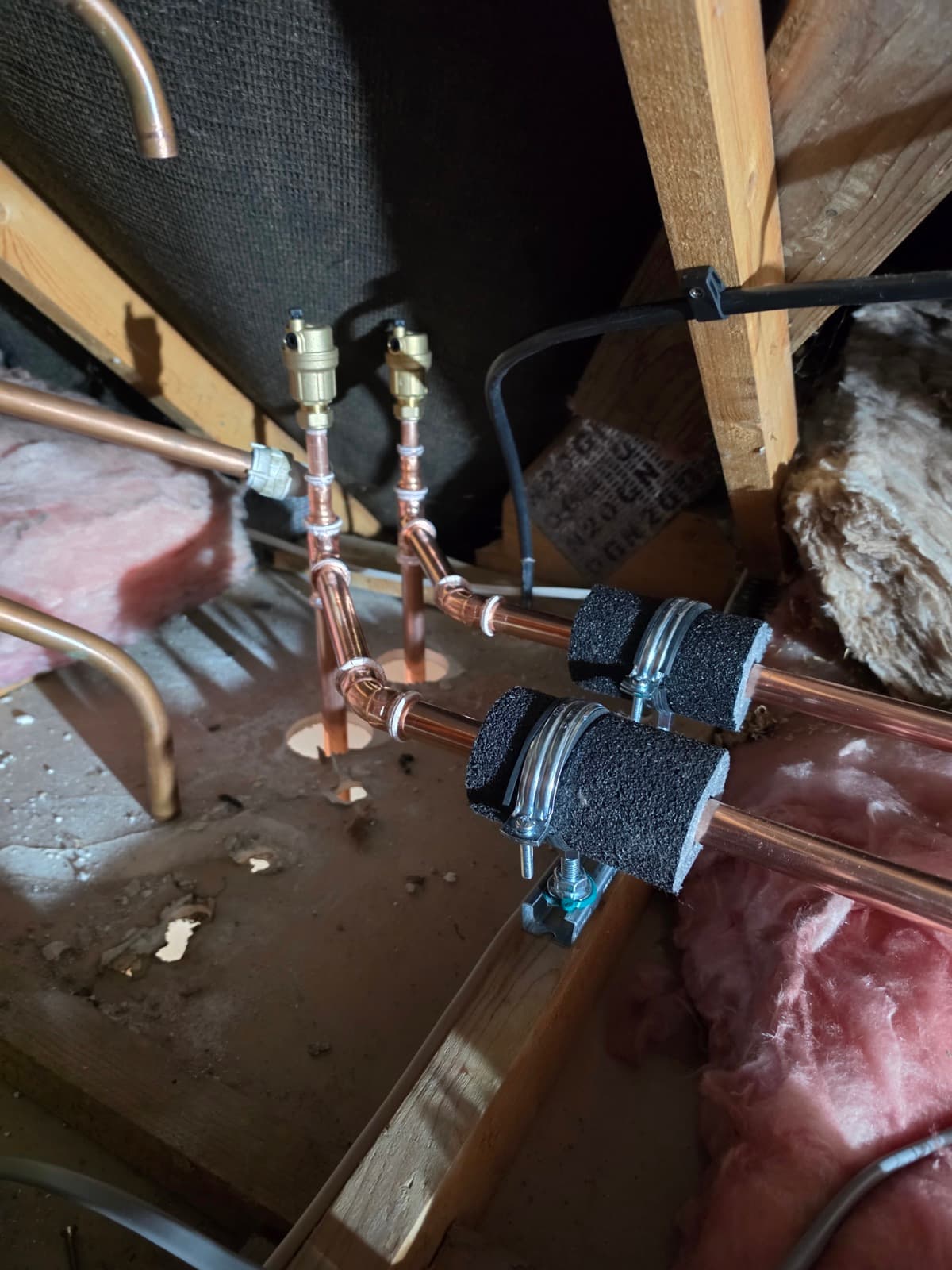
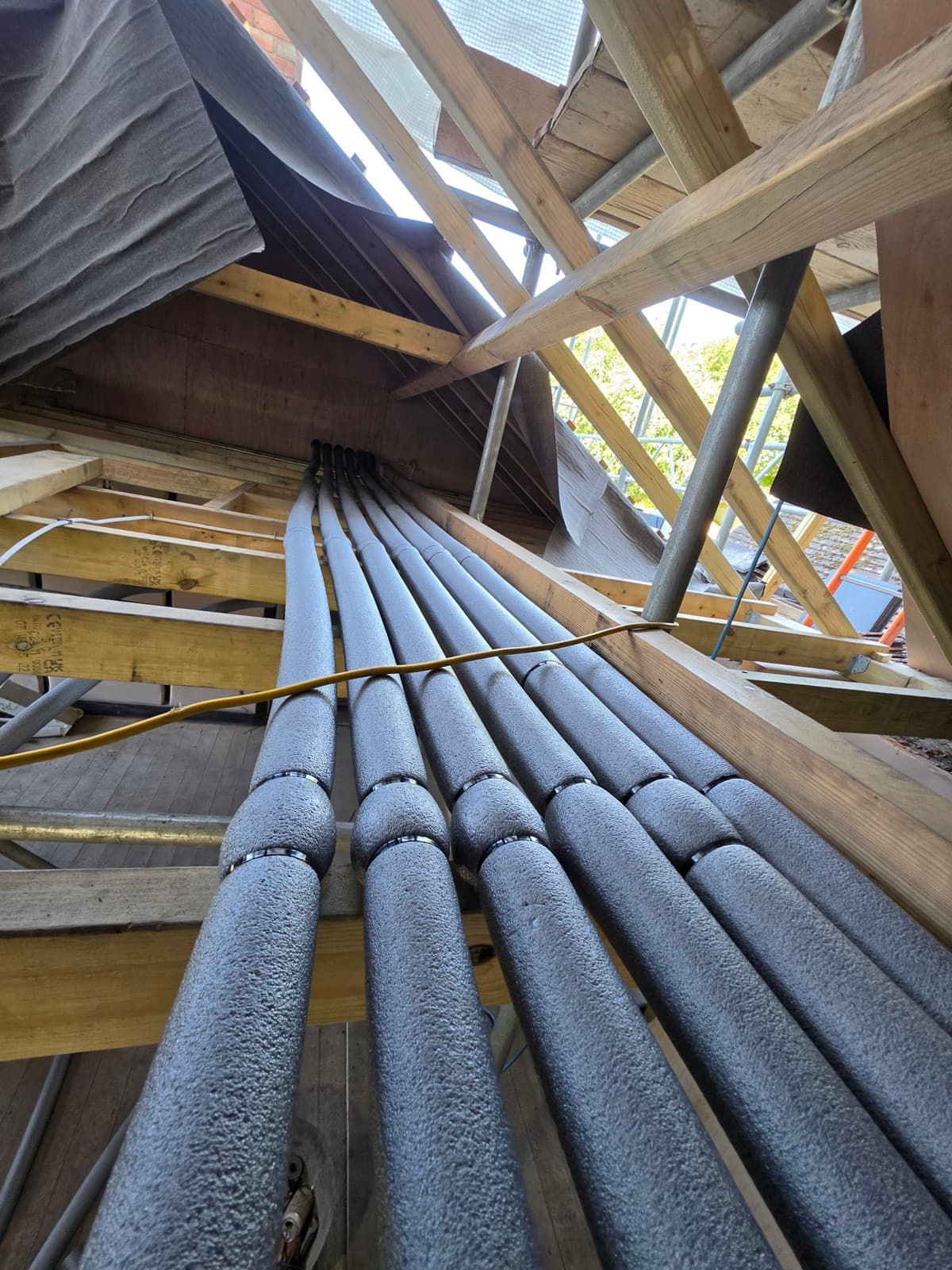
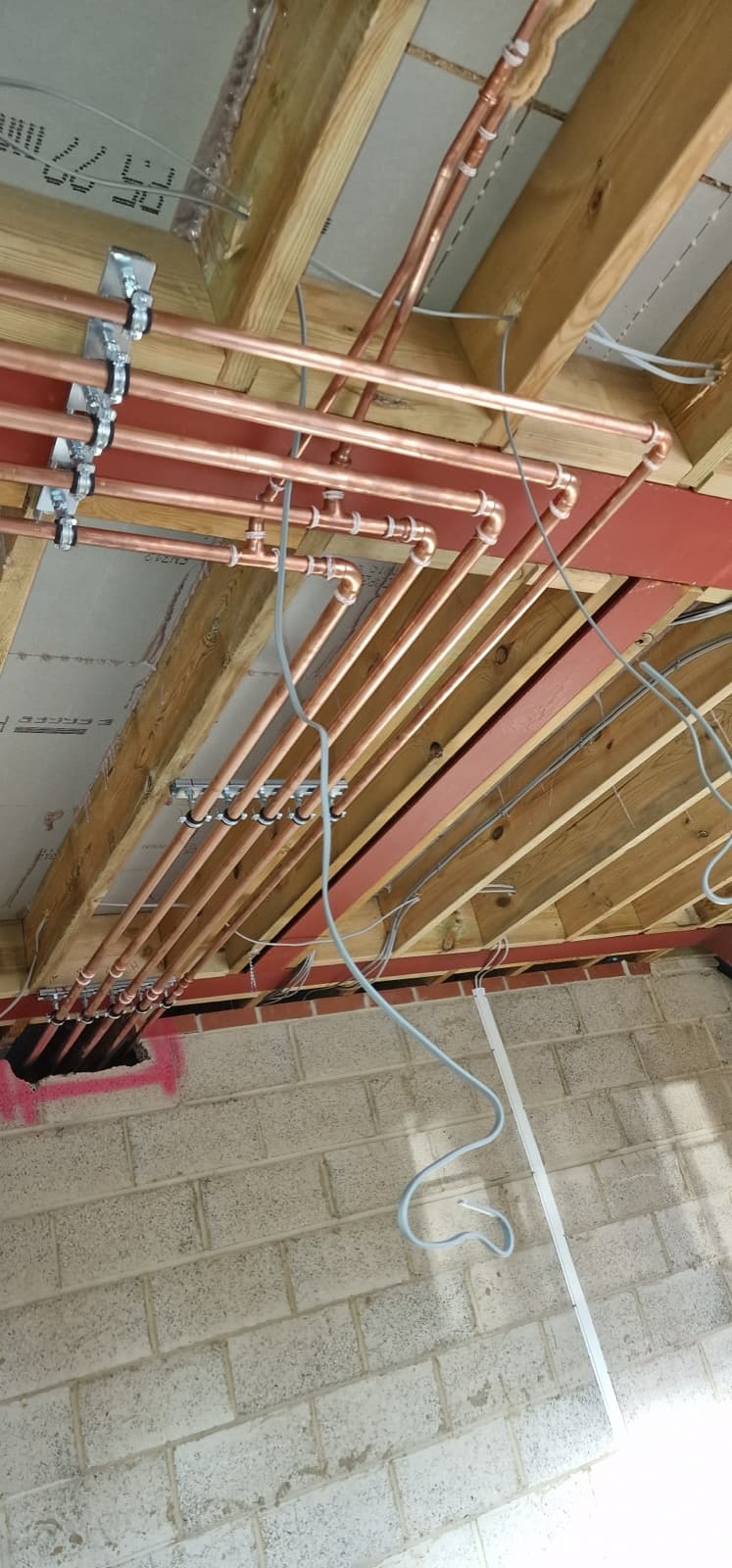
Concealed and buried pipework: doing it properly
- Joints should be accessible wherever reasonably possible. If a joint has to be concealed, it should be a jointing method suited to burial rather than a compression fitting behind plasterboard
- Pipe in a solid floor needs protection against corrosion and against the screed, usually a sleeve or a protective wrap
- Pipe in a wall needs protection against later fixings
- Insulation on anything in an unheated space, without exception
- Note where it runs. Photograph first fix pipework before floors go down and walls are boarded. Nobody ever regrets having those photographs, and everybody who does not have them wishes they did
That last point costs nothing and saves real money later. Take pictures before it disappears.
Stopcocks and isolating valves
Worth including here because they are pipework and because they matter more than their cost suggests.
Every property should have a working internal stopcock, and every fitting should have an isolating valve you can actually reach. In a very hard water area these seize, which turns a small repair into a whole-property shutdown at the worst moment.
Test them annually. Replace any that will not close. Our stopcock guide covers how.
Pipework in Milton Keynes: the local picture
1970s estates, Beanhill, Coffee Hall, Netherfield, Fishermead, Conniburrow and Bradville. Original copper, frequently microbore on the heating side, and fifty years of alterations. Failures cluster at reworked soldered joints and at fittings buried in places nobody should have buried them.
1980s and 1990s estates, Furzton, Emerson Valley, Shenley Brook End and Loughton. The transition era where push-fit appears alongside copper. Both materials are fine. Installation quality varies considerably.
Newer estates, Brooklands, Whitehouse, Fairfields, Oakgrove, Tattenhoe Park and Glebe Farm. Modern plastic pipework in good condition. The complication is underfloor heating in ground floor screed, which needs locating before any floor penetration.
Older property in Stony Stratford, Newport Pagnell, Olney and Wolverton. Mixed materials, occasional lead and steel, imperial sizes needing adaptation, and runs installed before anyone considered future access.
Hard water throughout. At around 300 mg/l across the city and roughly 317 in MK8, scale narrows older pipework gradually and seizes valves.
Checklist
- Know where your stopcock is and test it annually
- Test every isolating valve, and replace any that will not close
- Lag every pipe in an unheated space
- Photograph first fix pipework before it is covered
- If you have push-fit, ask whether inserts were used
- Before drilling into floors or walls, establish where pipes run
- If a run has failed twice, replace it rather than repairing it again
- On microbore, check the pipe size before upsizing a radiator
Frequently asked questions
Copper or plastic, which is better?
Both are good when installed properly. Copper is rigid and tidy where visible. Plastic is quicker, more tolerant of freezing, and flexible. The installation matters far more than the material.
What is microbore and is it a problem?
Small bore heating pipework, typically 8mm or 10mm, common in 1970s and 1980s Milton Keynes housing. Not a problem in itself, but it silts more readily and it limits capacity when you want to extend or upsize.
Can you replace pipework without lifting all my floors?
Frequently yes, by re-routing along accessible paths rather than following the original run. We look for the least disruptive route rather than the most obvious one.
Do I have lead pipes?
Possible in older property. Lead is dull grey, soft enough to mark with a coin, and gives a dull sound when tapped. If you suspect it, worth having it identified properly.
Why does my pipework bang?
Usually water hammer from a fast-closing valve, most often a washing machine or dishwasher, or pipes expanding against joists and clips. Both are fixable and worth fixing, since water hammer stresses joints over time.
Can you work on a property while we live in it?
Yes. We plan the isolation so you keep water where possible and we tell you in advance when it needs to go off.
Do you do pipework in commercial premises?
Yes, for offices, shops and small commercial units.
Do you install pipework for extensions and conversions?
Yes. Our loft conversion and extension page covers the capacity questions that come with it.
You may also need
Get it looked at properly
Call 07514 312117 or send a WhatsApp with a photo of the pipework. Gas Safe registered 981362, CIPHE member, fully insured.