
Radiator Installation and Repair in Milton Keynes
Tell Us About the Job
Tell us about the job in two minutes and we’ll come back to you with a clear, fixed price.
Radiators are the part of a heating system people actually interact with, and the part most often changed for the wrong reason. A radiator that never gets hot is usually not a faulty radiator. A radiator that heats the room poorly is often exactly the right radiator, fitted to a system running at the wrong temperature.
We install, replace and repair radiators across Milton Keynes and the surrounding towns, for homes, rental properties and commercial premises. Gas Safe registered, registration number 981362.
If your radiators are cold and you want to work out why before calling anyone, our central heating repairs page walks through what the pattern of cold spots tells you. This page is about specifying, replacing and installing them.
- Gas Safe registered 981362
- Fixed price agreed before we start
- Milton Keynes and 20 miles around
- 8am – 8pm, Mon to Sat
Last updated
Sizing: the thing that has changed
Radiator sizing used to be simple because everyone designed around a flow temperature of 75 to 80°C. That is no longer the case.
Part L of the Building Regulations now requires new and fully replaced wet heating systems to be designed for a maximum flow temperature of 55°C. The reason is that a condensing boiler only reaches its rated efficiency when the return temperature is low enough for it to condense. Run it hot and you have a very expensive non-condensing boiler.
The consequence for radiators is direct: a radiator delivers less heat at a lower flow temperature, so it needs to be larger to do the same job. A radiator correctly sized for 75°C is undersized at 55°C.
This is why a lot of people who replaced a boiler and expected lower bills did not get them. The boiler can run efficiently. The radiators will not let it, so the installer turns the flow temperature back up, and the efficiency goes with it.
If you are replacing radiators, this is the moment to size them properly. If you are replacing them one at a time as they fail, it is worth knowing that the sizes on the wall now may not be the sizes you want.
How sizing is worked out
Room by room heat loss, based on dimensions, external wall area, glazing, and insulation level. That produces a heat requirement in watts or BTU for each room. Radiator output is then matched to it at the design flow temperature, not at the manufacturer’s headline figure, which is usually quoted at a higher temperature than your system will run.
Ask any installer what temperature the quoted output is based on. It is a fair question and the answer tells you a lot.
Types, and where each makes sense
Panel radiators.
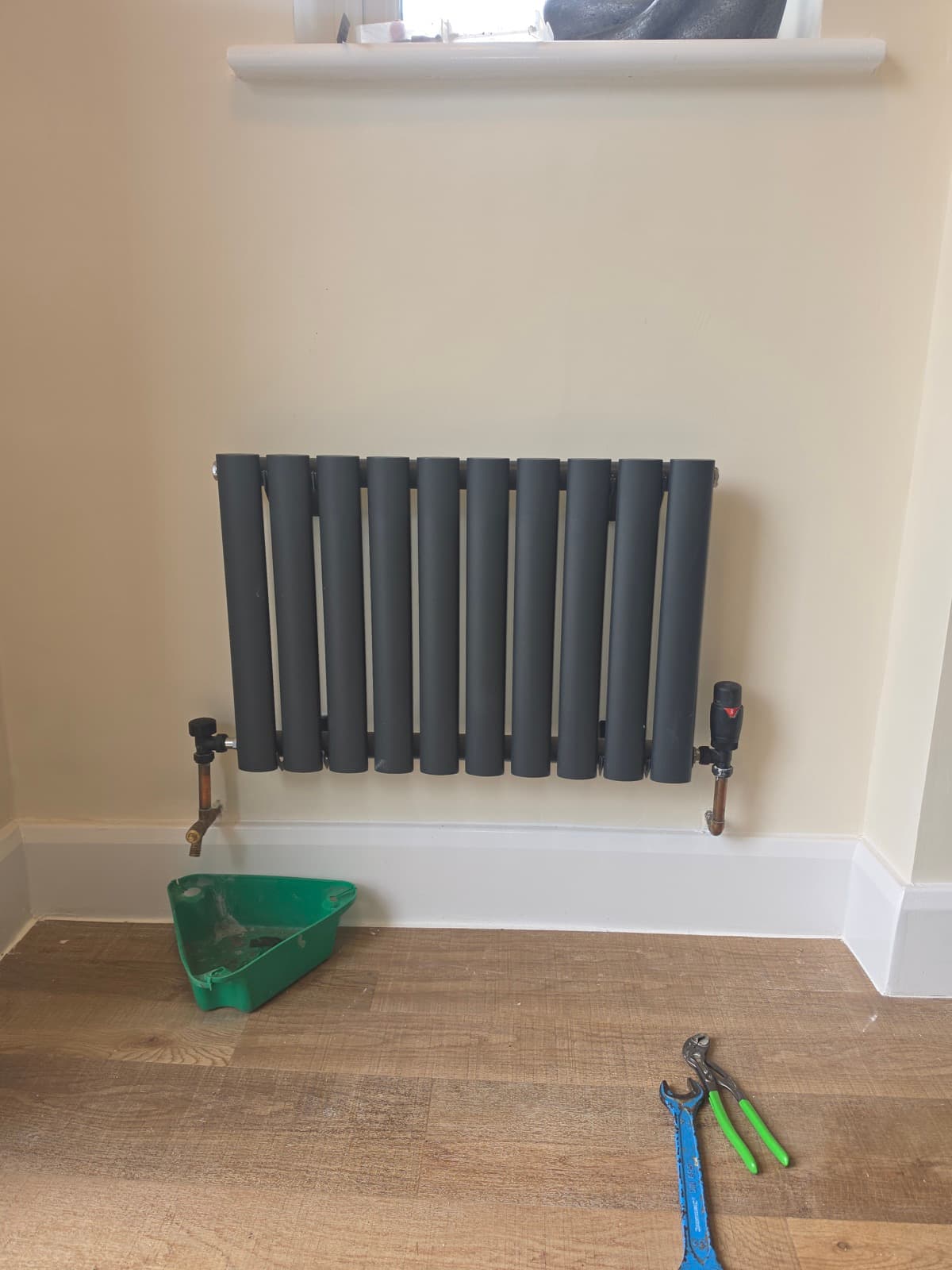
Single, double, with or without convector fins. The standard, best output per pound, and the widest size range. A double panel double convector gives substantially more output than a single in the same wall space, which matters when you are sizing for lower flow temperatures.
Column radiators.
Period look, popular in the Victorian property around Stony Stratford, Wolverton and Newport Pagnell. Lower output for their size and considerably heavier, which matters for wall fixings on stud walls.
Heated towel rails.
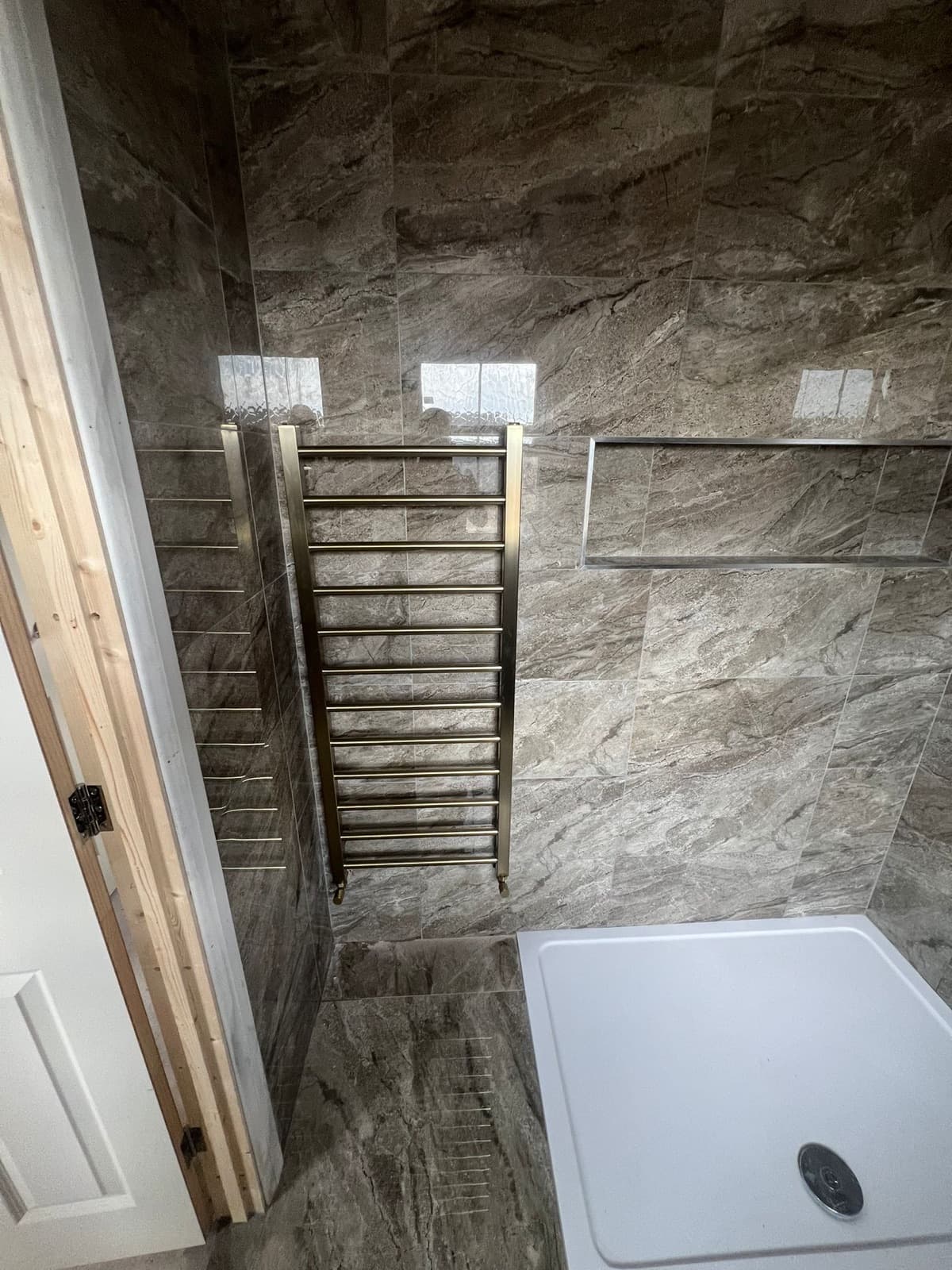
Good for bathrooms, poor as the primary heat source for the room. A towel rail’s output figure assumes it is not covered in towels, which it will be. In a bathroom that needs real heat, a towel rail plus a small panel radiator, or underfloor, is more honest than a towel rail alone.
Low surface temperature radiators.
Relevant for properties with young children, elderly or vulnerable occupants, and required in some commercial and care settings.
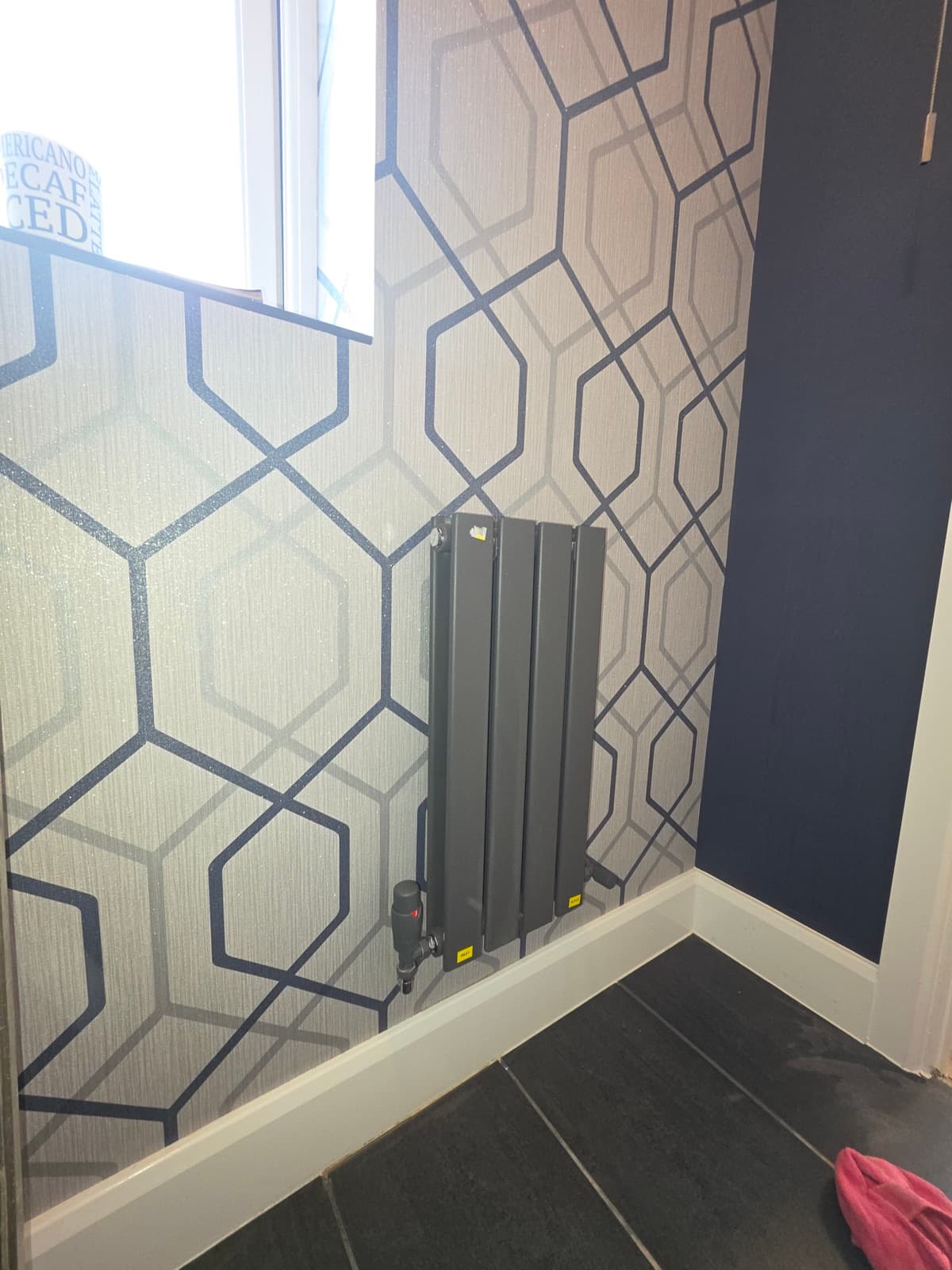
Vertical radiators.
Useful where wall space is tight, particularly in the compact bathrooms and kitchens common in the 1970s Milton Keynes estates. Output per square metre of wall is usually lower than a horizontal equivalent, so check the figures rather than assuming.
Replacing, adding, or repairing
Repair makes sense for
leaking valve connections, seized thermostatic valve pins, air locks, and radiators that are cold at the bottom because of sludge, which is a system cleaning job rather than a radiator job.
Replacement makes sense when
the radiator is leaking from the seam or the panel rather than the connections, when it is heavily corroded internally, or when it is simply too small for the room at the flow temperature the system runs at.
Adding a radiator
is straightforward in principle and needs thinking through in practice. The existing system has a finite capacity, and adding load without checking pump capacity and pipe sizing is how the far end of the house ends up cold. This comes up constantly with loft conversions and extensions.
Radiators in Milton Keynes: the local picture
Microbore
A lot of the 1970s and 1980s housing here runs microbore, typically 8mm or 10mm copper from a manifold to each radiator. Two consequences for radiator work.
First, microbore silts up, so a single cold radiator on an otherwise healthy system is often a blocked leg rather than a faulty radiator. Second, microbore has limited capacity, so upsizing a radiator on a microbore leg may not deliver the output you calculated, because the pipe cannot supply it.
Beanhill, Coffee Hall, Netherfield, Fishermead, Conniburrow and Bradville are where this is most common. Worth checking pipe size before ordering a larger radiator.
By area
1980s and 1990s estates, Furzton, Emerson Valley, Shenley Brook End and Loughton. Radiators from the original installation are now at the age where internal corrosion is producing sludge steadily, and seam leaks start appearing.
Newer estates, Brooklands, Whitehouse, Fairfields, Oakgrove, Tattenhoe Park and Glebe Farm. Underfloor downstairs, radiators upstairs. The upstairs circuit often runs at the same low flow temperature as the underfloor, which makes correct radiator sizing more important, not less.
Older property in Stony Stratford, Newport Pagnell, Olney and Wolverton. Solid walls mean higher heat loss and therefore larger radiators, in rooms that frequently have less usable wall space. Vertical and column options come into their own, and the figures need checking rather than assuming.
Thermostatic valves
A seized thermostatic valve pin is one of the cheapest fixes in heating and one of the most commonly lived with. The symptom is a single radiator that stays cold regardless of where you set the valve.
They seize because they sit in one position all summer. Two things help:
- Open every thermostatic valve fully at the end of the heating season and leave them open through summer
- Run the heating briefly once a month over summer
Note that the radiator in the room with the room thermostat should not have a thermostatic valve, or the two controls fight each other. This is a common installation error and it is worth checking in your own house.
Balancing
A system that has never been balanced delivers too much flow to the radiators nearest the boiler and too little to the ones furthest away. The result is the classic complaint: the hall is roasting, the back bedroom never warms up.
Balancing sets the lockshield valve on each radiator so flow is distributed according to what each radiator actually needs. It is done with the system hot, measuring the temperature difference across each radiator, and it takes time to do properly.
Any radiator work changes the balance. If someone fits radiators and leaves without rebalancing, the job is not finished.
Before you order radiators
- Have the room heat loss calculated rather than matching the size already on the wall
- Confirm what flow temperature the output figures are quoted at
- Check the pipe size feeding the radiator, particularly if the property is microbore
- Check wall construction and fixings, especially for column radiators and anything on a stud wall
- Decide valve type and position before ordering, since valve centres vary
- Make sure the radiator in the thermostat room does not get a thermostatic valve
- Confirm the system will be rebalanced afterwards
- If several radiators are being changed, ask whether the system should be flushed at the same time
Frequently asked questions
Why is one radiator always cold?
Most commonly a seized thermostatic valve pin, a closed lockshield, or on older Milton Keynes properties a silted microbore leg. Our central heating repairs page covers the diagnostics by cold spot pattern.
Can I just replace a radiator with a bigger one?
Sometimes. Check the pipe feeding it can supply the extra output, and check the system as a whole has capacity. On microbore, upsizing frequently does not deliver what the specification suggests.
Do I need to drain the whole system to change one radiator?
Usually not. If the radiator has isolating valves at both ends, it can be isolated and removed with the rest of the system intact.
Are vertical radiators as good as horizontal?
They fit where horizontal ones cannot, which is often the point. Output per unit of wall space is generally lower, so check the figures against the room’s heat requirement rather than assuming.
Should the bathroom have a towel rail or a radiator?
A towel rail alone often underheats a bathroom, particularly once it is doing its actual job and holding towels. In a bathroom that needs real warmth, plan for more than the towel rail.
Why is my house colder since the new boiler?
Frequently because the system is now running at a lower flow temperature and the radiators were sized for a higher one. Correctly sized radiators solve it. Turning the flow temperature back up hides it and costs you the efficiency.
Do you fit radiators in rental properties?
Yes, and replacements at change of tenancy are straightforward to schedule while a property is empty.
Do you cover commercial premises?
Yes, including low surface temperature radiators where the setting requires them.
You may also need
Get it sized properly
Call 07514 312117 or send a WhatsApp with a photo of the radiator and the room. Gas Safe registered 981362, CIPHE member, fully insured.