
Central Heating Installation in Milton Keynes
Tell Us About the Job
Tell us about the job in two minutes and we’ll come back to you with a clear, fixed price.
A new boiler on an old system is not a new heating system. It is a new boiler working around whatever the previous forty years left behind: radiators sized for a different flow temperature, pipework that has been extended three times, and controls that were state of the art when the second estate phase went up.
That is fine as far as it goes, and often it is the right decision. But it is worth knowing the difference, because a lot of people pay for a boiler expecting the result of a system, and are then disappointed that the far end of the house still does not warm up.
We install full central heating systems across Milton Keynes and the surrounding towns, in homes, rental properties and commercial premises. Gas Safe registered, registration number 981362.
- Gas Safe registered 981362
- Fixed price agreed before we start
- Milton Keynes and 20 miles around
- 8am – 8pm, Mon to Sat
Last updated
What a full installation involves
The heat loss calculation
Everything follows from this and it is the step most often skipped. A room-by-room heat loss calculation works out how much heat each space actually needs, based on its dimensions, its external walls, its glazing and its insulation.
From that you get radiator sizes, and from the total you get the boiler output. Doing it the other way round, picking a boiler and then fitting whatever radiators fit the wall, is how you end up with a system that is oversized in some rooms and undersized in others.
The boiler and hot water decision
Covered in more depth on our boiler installation page, but the short version is that mains flow rate and simultaneous bathroom use decide it. A combi for most one and two bathroom properties with a decent main. A system boiler and unvented cylinder where more than one bathroom is in use at once, or where the mains cannot support a combi.
Radiator sizing at lower flow temperatures
This is the part that has changed and that most people have not caught up with.
Part L of the Building Regulations now requires new and fully replaced wet heating systems to be designed for a maximum flow temperature of 55°C, rather than the 75 to 80°C older systems ran at. The reason is efficiency: a condensing boiler only condenses, and only reaches its rated efficiency, when the return temperature is low enough.
The consequence is that radiators need to be larger to deliver the same heat at a lower temperature. A radiator sized for 75°C flow will underperform at 55°C. This is precisely why a boiler swap onto original radiators often fails to deliver the bill reduction people expect. The boiler is capable of running efficiently. The system will not let it.
Designing the whole system at once is how you actually get the efficiency you paid for.
Pipework
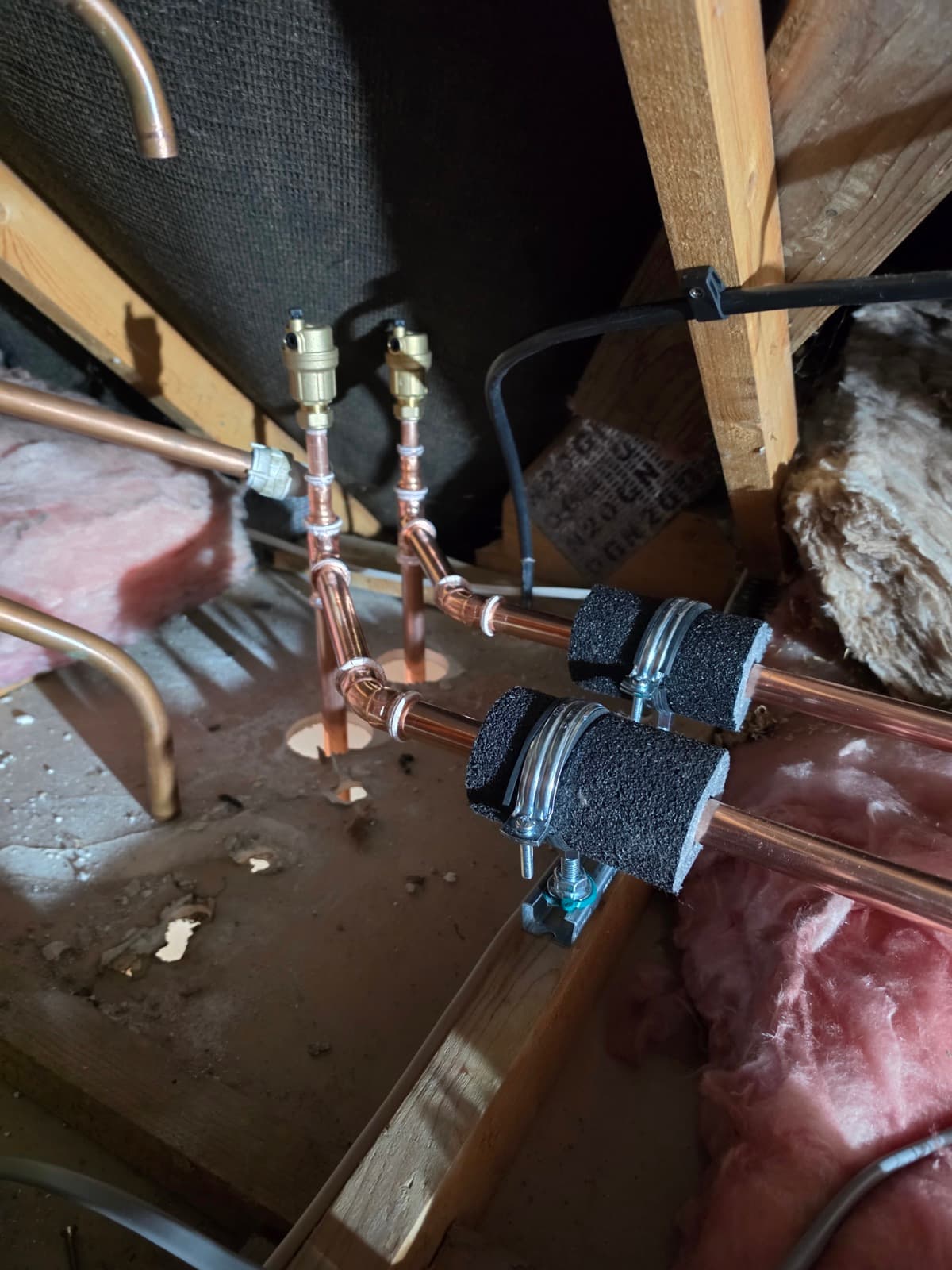
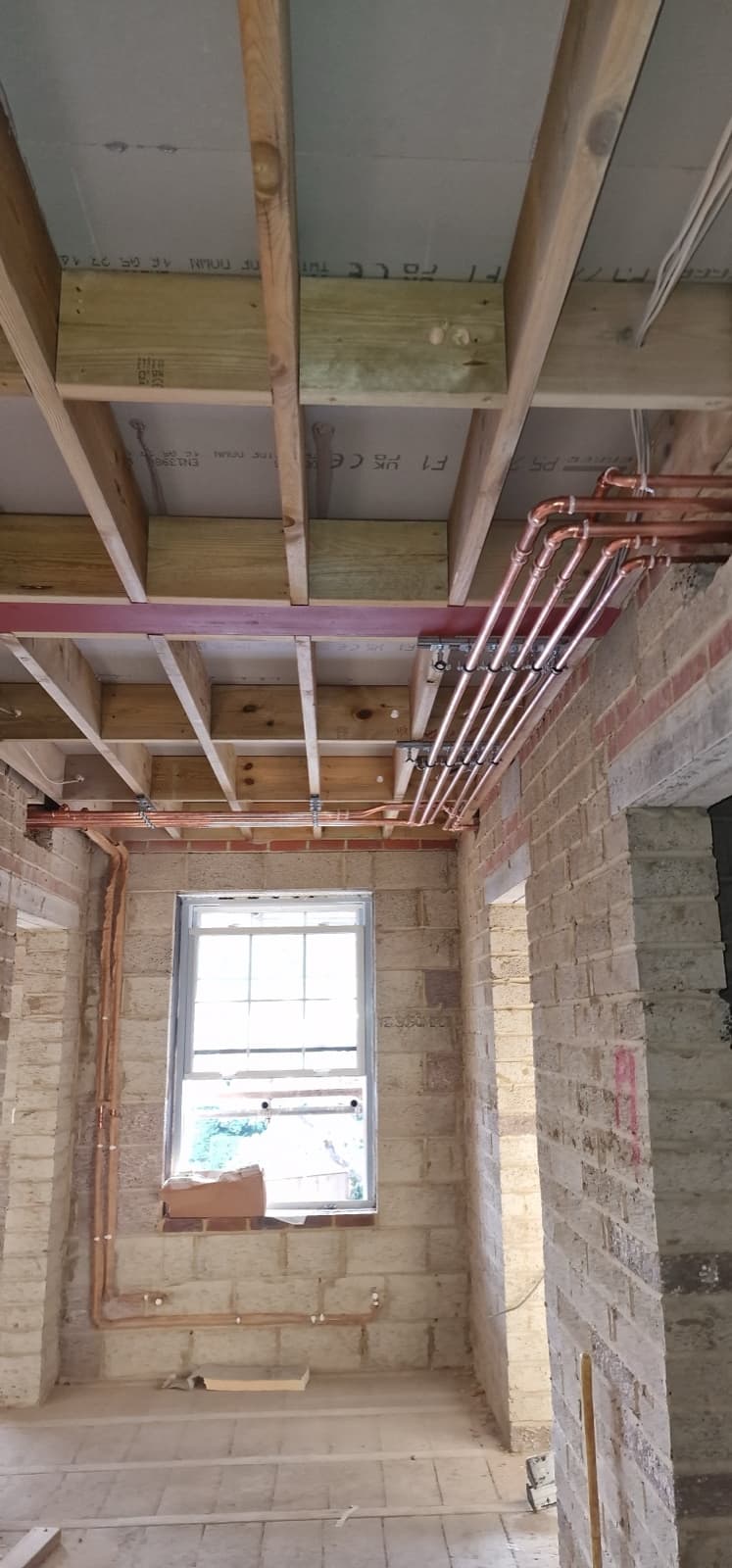
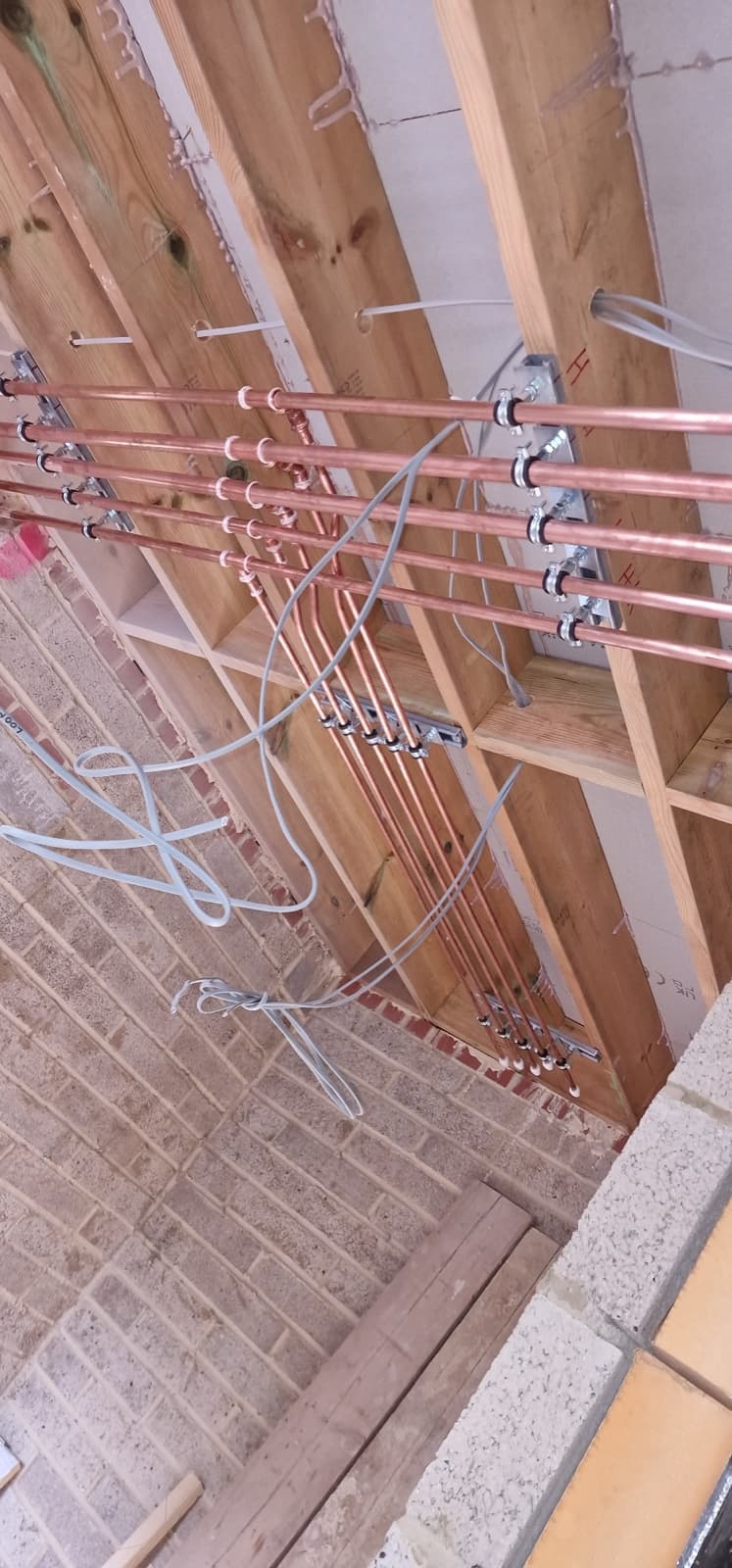
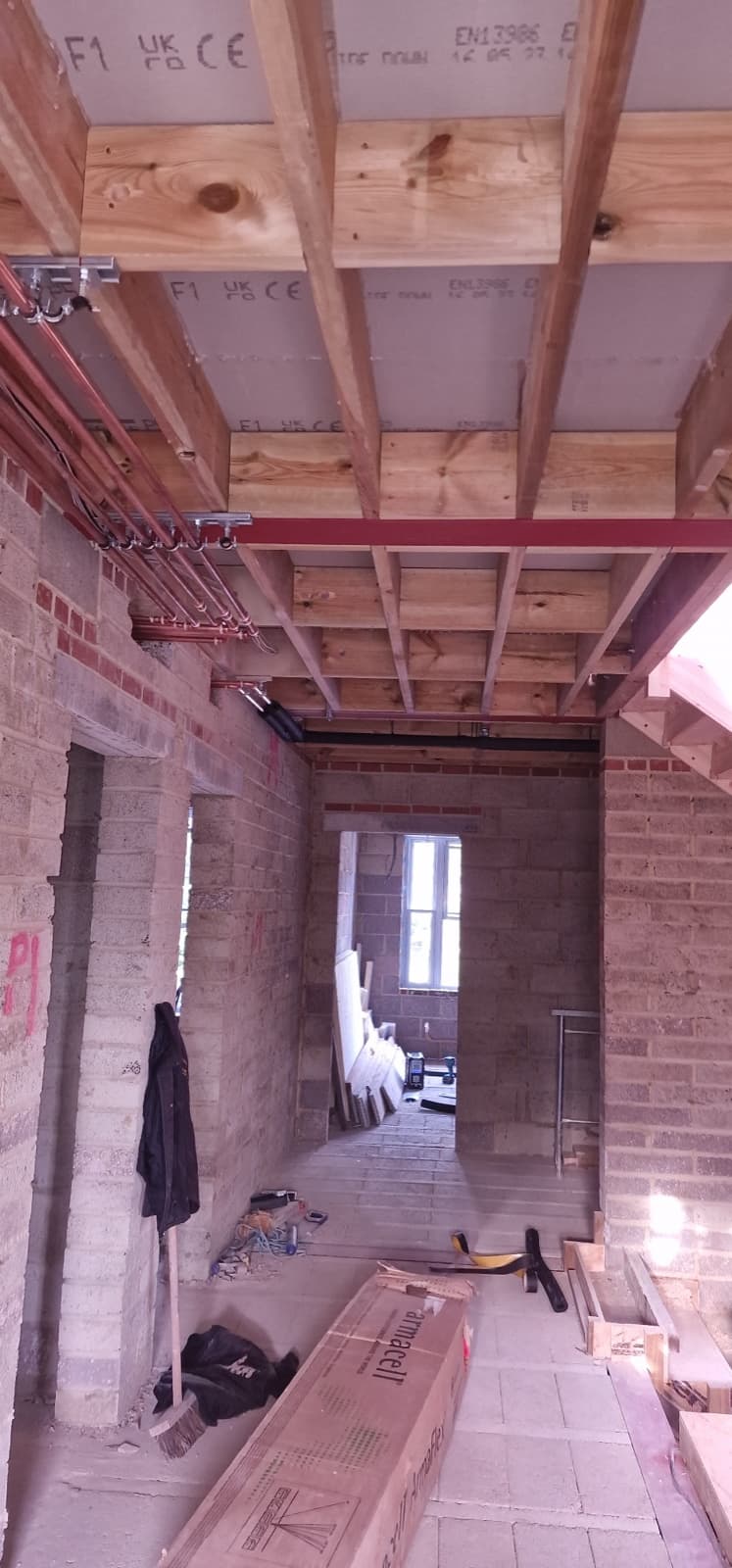
A full installation is the moment to deal with pipework that is not fit for purpose, particularly microbore that has silted up, or runs that were extended for an extension without the capacity being reconsidered. Doing it later means lifting the same floors twice.
Controls and zoning
At minimum, a programmer, a room thermostat with boiler interlock, and thermostatic valves on radiators other than the one in the room with the thermostat.
Beyond that, zoning is worth considering in larger properties: separate circuits for upstairs and downstairs, or for a converted loft or extension that is used differently from the rest of the house. Weather compensation, which adjusts flow temperature to outside conditions, is the strongest performer for efficiency. Smart controls are more flexible and easier to live with. Both satisfy Boiler Plus requirements on a combi installation.
What the regulations require
Boiler Plus.
Since April 2018, every new gas boiler in England must achieve at least 92% ErP seasonal efficiency, and must have time and temperature controls with boiler interlock. A combi installation additionally requires one of: weather compensation, load compensation, a qualifying smart thermostat, or flue gas heat recovery.
Part L.
New and fully replaced wet systems designed to a maximum 55°C flow temperature.
Building Control notification.
Carried out by the Gas Safe registered installer, with a compliance certificate issued to you afterwards.
Central heating in Milton Keynes: the local picture
Microbore, and what to do about it
A large share of the 1970s and 1980s Milton Keynes housing was plumbed in microbore, typically 8mm or 10mm copper running from a manifold to each radiator. It installs quickly and it works, but the small diameter silts up with magnetite far more readily than 15mm pipe.
On a full system installation, microbore forces a decision. You can flush it and keep it, which is reasonable if it is in good condition. You can replace it, which is more disruptive and more expensive but removes the problem permanently. What you should not do is fit a new boiler and larger radiators onto silted microbore and expect the system to perform.
Beanhill, Coffee Hall, Netherfield, Fishermead, Conniburrow and Bradville are where this comes up most.
By area
1980s and 1990s estates, Furzton, Emerson Valley, Shenley Brook End and Loughton. Many still on a system boiler and vented cylinder from the late 1990s, with radiators of the same vintage. These are the properties where a full system replacement makes the most difference, because everything is at end of life simultaneously.
Newer estates, Brooklands, Whitehouse, Fairfields, Oakgrove, Tattenhoe Park and Glebe Farm. Underfloor heating on the ground floor with radiators above. Underfloor runs naturally at low flow temperatures, so these properties are already part-way to what Part L now asks for, and the upstairs circuit is where the design attention goes.
Older property in Stony Stratford, Newport Pagnell, Olney and Wolverton. Solid walls mean higher heat loss and therefore larger radiators, which is a real constraint in rooms with limited wall space. Worth resolving at design stage rather than discovering on fitting day.
Hard water
Milton Keynes averages around 300 mg/l of calcium carbonate through Anglian Water, MK8 measures roughly 317, and the UK average is 207. On a sealed heating system the water is not replaced, so the heating circuit itself is largely protected. The exposure is on the domestic hot water side and on any system that gets topped up regularly. We fit a scale reducer on the cold mains feed as standard.
Full system or boiler swap?
An honest way to decide:
A boiler swap is enough when
the radiators are adequately sized and in good condition, the pipework is sound, the system water is clean, and your complaint is simply that the boiler is old.
A full system is worth it when
radiators are corroded or clearly undersized, the pipework is silted microbore, the system needs topping up regularly, parts of the house never warm up properly, or you are already having floors up for other work.
The middle option
, which suits a lot of Milton Keynes properties, is a new boiler plus targeted radiator replacement in the rooms that underperform, plus a thorough flush and a filter. It costs less than a full system and solves most of what people actually complain about.
We will tell you which of the three we think applies, and why.
What happens on the job
- 1
Survey and room-by-room heat loss calculation
- 2
Design: radiator schedule, pipe sizing, boiler output, control strategy, all agreed with you before anything is ordered
- 3
Strip out, with the property left usable overnight where the job runs to several days
- 4
First fix pipework
- 5
Boiler, cylinder and radiators installed
- 6
Fill, add inhibitor, fit magnetic filter and scale reducer
- 7
Commission, balance every radiator, set flow temperature for the design rather than leaving it at factory default
- 8
Notify Building Control, register warranties, hand over the controls properly
Before you commit
- Ask for the heat loss calculation, not just a boiler size
- Ask what flow temperature the system is designed around
- Ask whether the radiator sizes were calculated or assumed
- Ask what is happening to the existing pipework, particularly if it is microbore
- Confirm a magnetic filter and inhibitor are included
- Confirm a scale reducer is included, given the water here
- Ask how long you will be without heating and hot water
- Confirm Building Control notification and who registers the warranties
- Ask whether the system will be balanced, and what that means
Frequently asked questions
How long does a full central heating installation take?
Typically three to five days for a standard house, longer where pipework is being replaced throughout or where a cylinder is being added. We give you a realistic schedule at quote stage.
Do I have to replace all my radiators?
No. Some will be correctly sized already. The heat loss calculation tells us which ones need changing and which are fine, which usually costs less than replacing everything.
Will a new system actually cut my bills?
A correctly designed system running at a low flow temperature will be meaningfully more efficient than an old one. A new boiler bolted onto undersized radiators will not, because it cannot condense properly. The design is where the saving comes from.
Can you install heating in a property with no existing system?
Yes, including new builds, conversions and properties coming off other heating types. Tell us what is there now.
What is zoning and do I need it?
Separate control of different parts of the property. Worth it in larger houses, in properties with a converted loft or extension used on a different schedule, and in anything with underfloor downstairs and radiators upstairs.
Do you install heating in rental properties?
Yes. We work with landlords across Milton Keynes on installations, repairs, servicing and gas safety certificates.
Do you do commercial heating installations?
Yes, for offices, shops and small commercial units.
You may also need
Get a design and a price
Call 07514 312117 or send a WhatsApp. Gas Safe registered 981362, CIPHE member, fully insured.